It’s March 2026 and the shift everyone predicted is no longer coming — it’s already here and moving faster than most teams can react. AI isn’t just assisting anymore; it’s becoming the backbone of how software gets built, how enterprises run, and how physical systems operate.
The real acceleration hit in Q1 2026: multi-agent systems in production, physical AI taking first real steps, and AI-native platforms replacing traditional dev stacks. If you’re still treating AI as a side feature, you’re already behind.
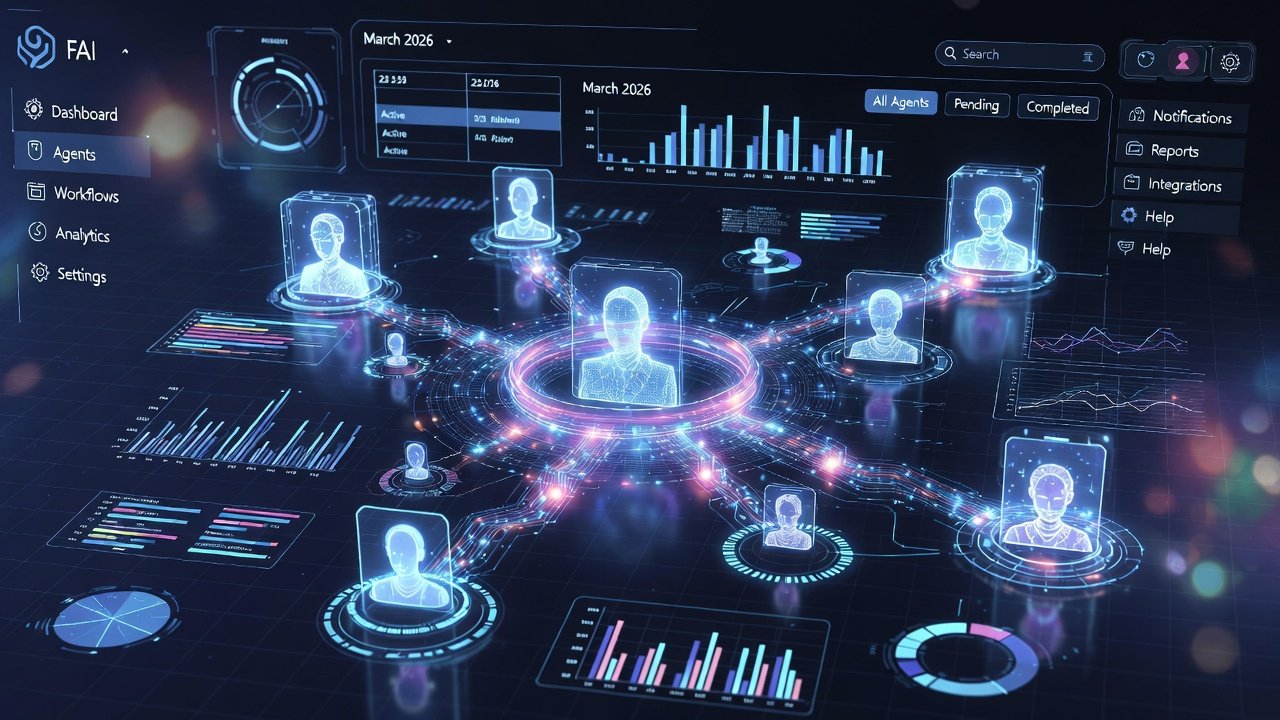
Multi-agent systems are now orchestrating complex enterprise workflows in real time.
The Core Shift: From Tools to Autonomous Orchestration
2025 was the year of generative hype. 2026 is the year agents stopped asking for permission.
Multiagent systems and agentic AI are no longer demos — Gartner and IDC both show 40%+ of enterprise apps embedding task-specific agents already, with production deployments scaling weekly. These aren’t chat wrappers; they reason, delegate, recover, and execute across tools without constant human babysitting.
Physical AI Is Leaving the Lab
Here’s where it gets interesting for gaming and real-world creators: Physical AI and humanoid robotics just crossed the inflection point.
Convergence of AI + robotics means agents now control physical hardware — from warehouse arms to prototype game peripherals. Indie studios are already using early physical AI to simulate player interactions in mixed reality setups. The leap from digital agents to embodied intelligence is happening now, not in 2030.
AI-Native Everything — Dev, Infra, Ops
Traditional dev platforms are dying fast. AI-native development environments (think Cursor on steroids, but enterprise-grade) are shipping code 5–10× faster with built-in agents handling testing, deployment, and optimization.
Cloud is evolving into “Cloud 3.0” — hybrid, sovereign, AI-optimized. Inference economics are forcing companies to rethink compute entirely. The winners aren’t buying more GPUs blindly; they’re building inference-first architectures.

Physical AI is bridging the gap between digital agents and real-world execution in 2026.
Real Talk: Hype Is Dead, Reality Is Expensive
Let’s cut the BS — not every agent project is winning. Gartner already warns 40%+ could get canned by 2027 if governance and ROI aren’t locked in early. Hallucinated plans, runaway token costs, and agents that quietly violate policy are real and happening right now.
Most teams waste months chasing the shiniest new model wrapper. The ones pulling ahead focus ruthlessly on: secure orchestration, human-in-the-loop fallbacks, and picking exactly one high-leverage workflow to agent-ify first. Everything else is noise.
How to Actually Catch This Wave in March 2026
You don’t need to wait for the next GTC keynote. Here’s what smart builders and studios are doing right now:
- Start with one painful workflow: Pick the most repetitive or error-prone process — quest generation, asset balancing, customer support triage — and give it to a multi-agent setup.
- Use mature frameworks today: LangGraph, CrewAI, or Microsoft’s agent orchestration tools are production-ready. Skip the experimental stuff.
- Build guardrails from day one: Enforce tool permissions, audit logs, cost caps, and mandatory human review on high-stakes actions.
- Track inference economics: Monitor token burn and switch to domain-specific or compressed models the second ROI dips.
- Experiment with physical extensions: If you’re in gaming/hardware, connect agents to simple robotics kits or AR/VR rigs — the early data is insane.

Teams adopting AI-native pipelines are seeing 5–10× faster iteration in early 2026.
Move Now or Get Moved
This isn’t another hype cycle. It’s infrastructure reshaping itself in real time. AI agents + physical AI + AI-native stacks are converging into something that looks more like a new operating system for the world than a toolset.
The people shipping with agents today will define the next decade. The rest will be explaining why they’re still manually doing what machines already handle autonomously.
Pick your workflow. Agent-ify it this month. The clock is ticking louder every week.